




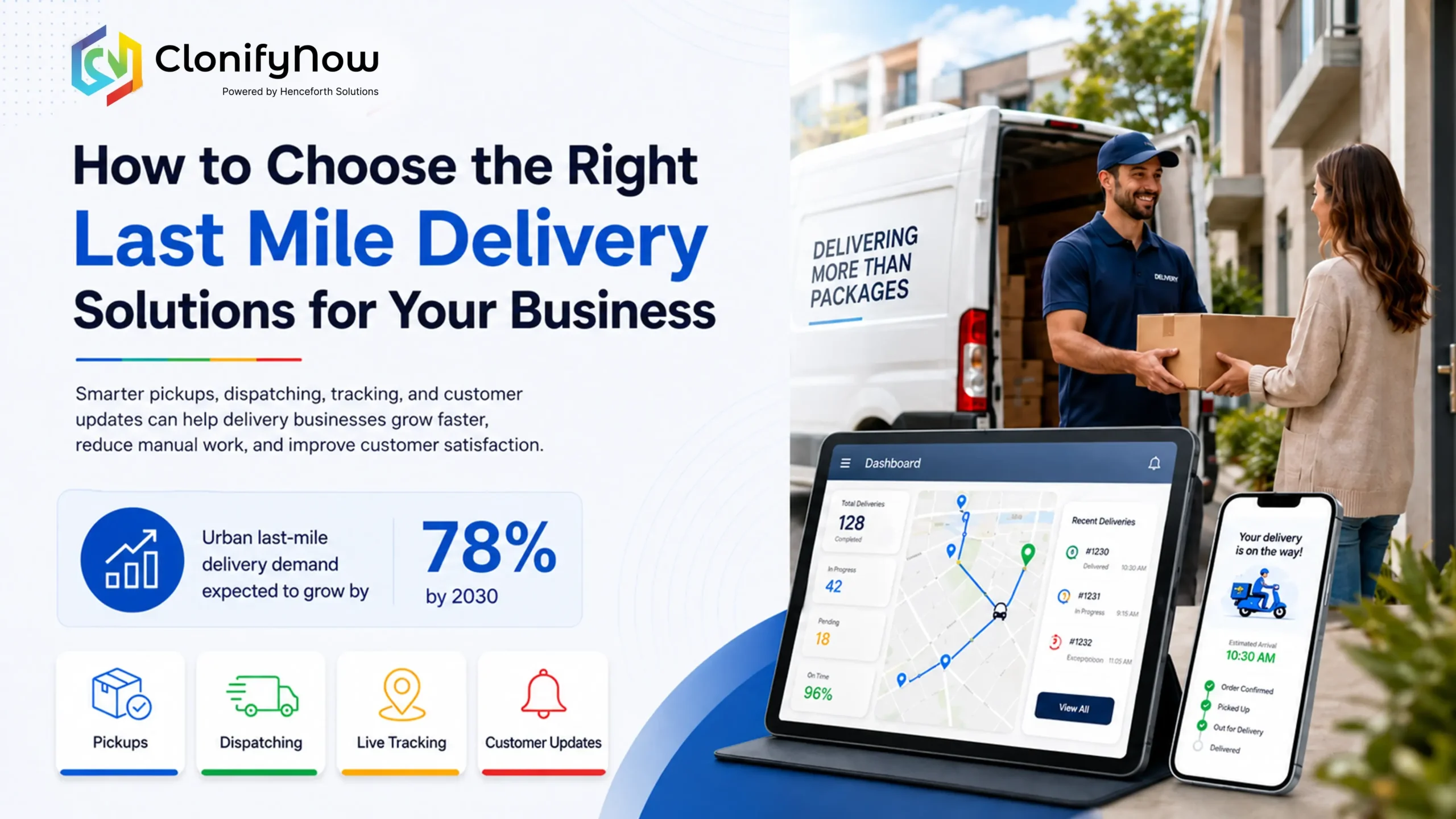
Choosing the right last-mile delivery solutions can shape how fast your business grows, how smoothly orders move, and how satisfied your customers feel. If you want to build a pickup and delivery app that works in real operations, the decision should start with your delivery workflow, customer experience, and long-term business goals. ClonifyNow helps businesses move faster with practical digital products built for growth. Did you know? Demand for urban last-mile delivery is expected to grow by 78% by 2030, leading to 36% more delivery vehicles in the world’s top 100 cities. In simple terms, the right solution should help you manage pickups, drop-offs, dispatching, and customer updates without adding unnecessary complexity. A well-planned system can improve efficiency, reduce manual work, and give your business a stronger foundation for scale.
Step 1: Understand what your business needs from a pickup and delivery app solution
A strong pickup and delivery app solution should make operations easier, not harder. Before choosing one, map out how your business handles pickup requests, drop-offs, driver coordination, and customer communication. If your team still relies on calls, messages, or spreadsheets, the right platform can bring everything into one connected workflow. The best solutions usually focus on speed, accuracy, and clear communication. Customers want to know when their pickup is confirmed, drivers need easy navigation, and admins need visibility into each task. That is where the right system becomes a business asset rather than just another app.
- Check whether the platform supports real-time task assignment.
- Make sure the customer journey is simple and fast.
- Look for live tracking and status updates.
- Choose a solution that can grow with your business needs.
Step 2: Compare the benefits of delivery management software for daily operations
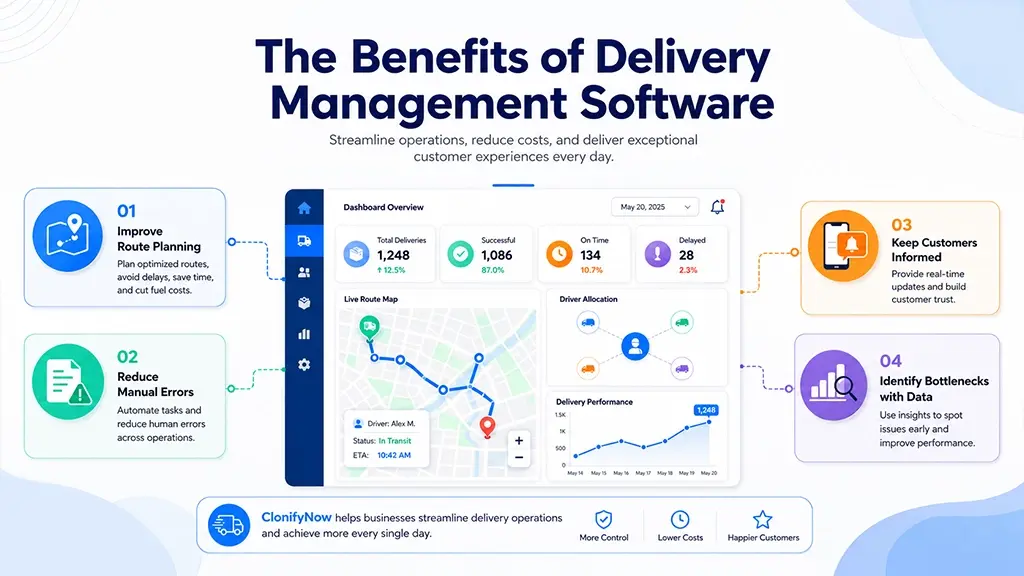
The benefits of delivery management software become clear when your business starts handling more orders. It helps you reduce delivery delays, improve routing, and manage teams with more control. Instead of relying on manual follow-up, you can use one system to track operations from start to finish. For businesses that want to stay competitive, this kind of software also improves customer trust. People value transparency, quick updates, and reliable service. When your delivery process feels organized, customers are more likely to return and recommend your brand. ClonifyNow supports this kind of operational clarity by helping businesses build systems around real delivery workflows rather than generic app features.
- Improve route planning and driver allocation.
- Reduce missed updates and manual errors.
- Keep customers informed throughout the delivery cycle.
- Use data to identify slow zones and bottlenecks.
Step 3: Check the cost to develop a delivery app before you decide
The cost to develop a delivery app depends on the features you include, the design complexity, and whether you choose a custom build or a ready-made setup. If you want advanced tracking, separate user panels, payment systems, and reporting tools, the budget will naturally rise. On the other hand, a focused launch can help you start lean and expand later. It is also important to think beyond the initial build. Maintenance, feature updates, and support all affect the total investment over time. That is why many businesses compare different launch models before deciding.”
- More features increase development effort.
- Custom design usually requires more time and resources.
- A ready-made model can reduce launch complexity.
- Long-term support should be part of the budget plan.
Step 4: Choose a system that supports growth and future scaling
The best last mile delivery solutions are the ones that match your current stage and your future plans. If you are just starting, you may want a simple system that lets you launch quickly. If you are already growing, you may need stronger reporting, automation, and zone management. This is also where building a pickup and delivery app becomes a smart business move. A well-designed app gives you direct control over how orders move, how drivers are assigned, and how customers experience your service. Instead of patching together multiple tools, you can create one structured platform that supports your workflow from day one.
- Start with the features your business needs most.
- Choose a platform that can handle more orders later.
- Keep the interface simple for customers and drivers.
- Make sure the system supports branding and operational control.
ClonifyNow can help you build that base with a practical approach that supports long-term growth.
Ready to make your delivery business faster?
If your business is ready to move beyond manual coordination, now is the time to invest in the right digital system. A good last-mile delivery solutions strategy should help you serve customers faster, keep drivers more organized, and support business growth with less friction. The smartest businesses choose tools that make daily work easier while still leaving room to scale. ClonifyNow understands that every delivery business has different needs, which is why the right platform should fit your workflow instead of forcing you to change it. If you want to stay efficient, competitive, and ready for growth, start with a solution built for real business outcomes.
FAQs about the last-mile delivery Solution
1. What are last-mile delivery solutions?
Last-mile delivery solutions are digital systems that help businesses manage the final stage of delivery, including pickups, route planning, tracking, and customer updates.
2. Why should I use a pickup and delivery app solution?
A pickup and delivery app solution helps you organize deliveries, reduce manual work, improve customer communication, and manage drivers more efficiently.
3. What are the benefits of delivery management software?
The benefits of delivery management software include better route planning, fewer delays, improved visibility, faster updates, and stronger customer trust.
4. How much does it cost to develop a delivery app?
The cost to develop a delivery app depends on features, design, customization, and whether you choose a custom build or a ready-made platform.
5. Can I build a pickup and delivery app for my business?
Yes. You can build a pickup and delivery app that fits your workflow, supports growth, and helps you manage orders, drivers, and customers in one system.
6. How do I choose the best last mile delivery solution?
Choose a solution that fits your business size, supports real-time tracking, handles scaling, and offers the features you need without unnecessary complexity.
7. Is a ready-made solution better for startups?
Yes, for many startups, a ready-made option can be faster and easier to launch because it reduces development time and helps you start operations sooner.


 +91-9464826889