





Building an app is just a small part of starting a business. Many entrepreneurs lock themselves in during the early phases of starting a business. This is usually the part of the process that includes building an app. They spend time planning out app design, planning out app features, and planning out the app launch. But what about ensuring that the app generates revenue?
Mobile app monetization means the method your app uses to generate revenue. This is the easiest aspect of starting a clone app. A clone app is an app that is built using a model that has already proven successful, like Uber, DoorDash, or Airbnb. If you get this right from the start, your clone app becomes a sustainable business. If you skip it, even a well-built platform can quietly fail to grow. A business model works best when it clearly connects value creation with revenue generation, which is why choosing the right monetization path early is important.
What Does Mobile App Monetization Mean?
If you are making an app, it should help you generate revenue at the end of the day. Charging users who book through the app, monthly fees, or displaying ads are all ways to create an app that generates revenue. The optimal monetization strategy depends on your app’s core purpose and the behavior of your users.
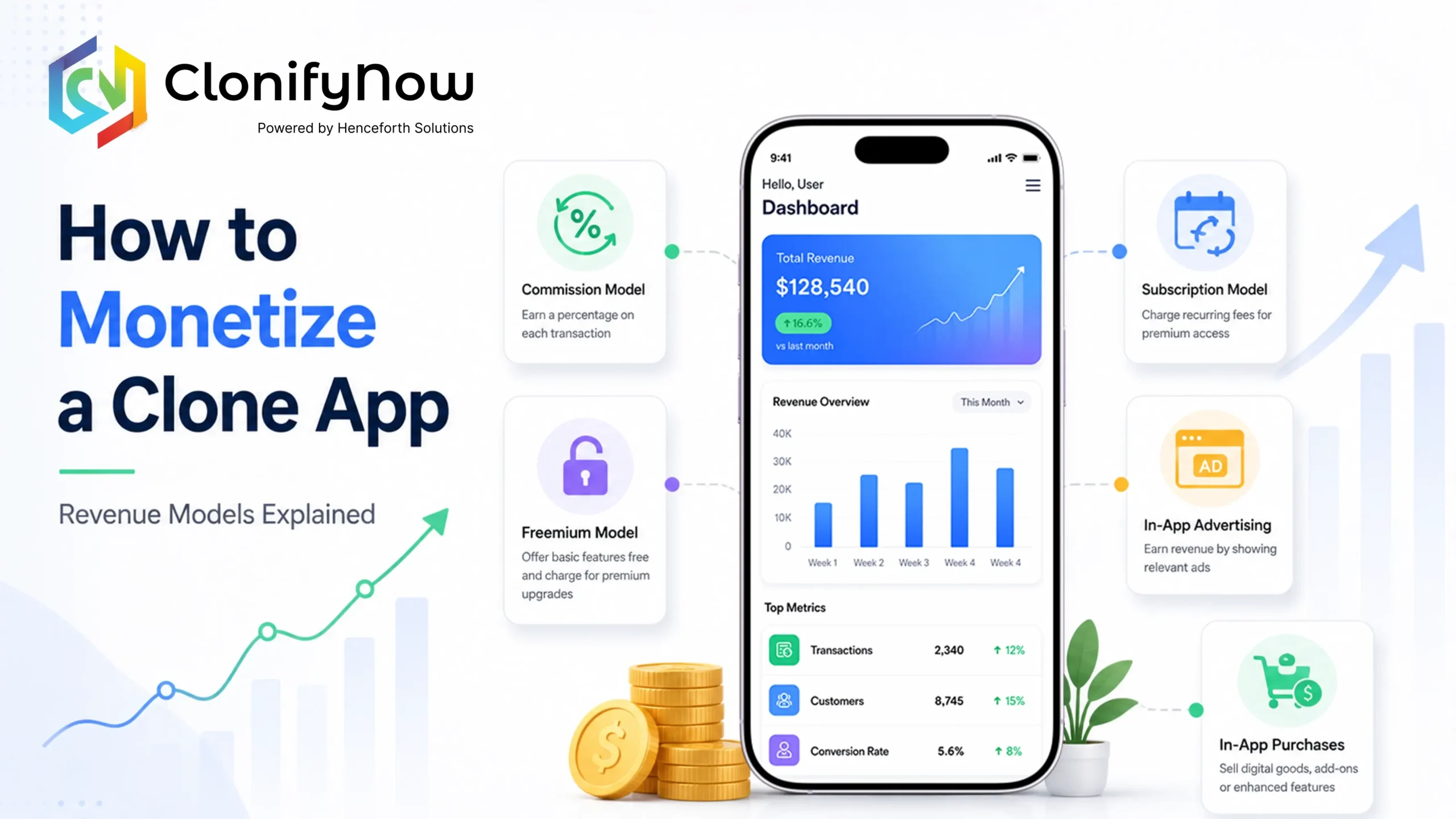
Revenue Model 1 : Commission Model
How It Works
In this model, after every transaction on your app, you get a small commission. For each cab someone books, you get a percentage of the fare. For every food order, you get a commission. For every completed job, a fee is charged by the platform. This is one of the most practical app monetization strategies for clone apps built around repeat transactions. This is the revenue model of Uber, Swiggy, and Urban Company. The app connects a customer and a service provider and makes money each time the customer and service provider engage in a transaction.
Best For
This model works best in an environment like a ride-hailing app, food and parcel delivery apps, a freelance marketplace app, or any other app where transactions take place regularly.
Revenue Model 2: Subscription Model
How It Works
This is a model where a user of the app pays a fixed amount every month or every year to access the app or its features. The app, therefore, gets a predictable revenue stream. This model applies to services that are used on a daily basis, like Netflix or Spotify.
For a clone app, this revenue model is applicable when the app provides a service that is used frequently by users, for example, a delivery service.
Best For
Grocery and delivery apps, home service platforms, and any app people use on a weekly or daily basis.
Revenue Model 3: Freemium Model
How It Works
In this model, the app is free to use or download. The best features of the app are made available to the user upon payment. Users test the app with the free version. Afterward, people can see the value, and a portion of those users upgrade. This is one of the best mobile app monetization strategies because it rapidly builds a user base without payment requirements and later offers the users an upgrade when they are most engaged.
Best For
Service marketplace apps, business tools, and platforms where the free version is useful but the paid version is clearly worth upgrading to.
Revenue Model 4: In-App Advertising
How It Works
You build a free app that allows a service where brands pay to show their advertisements nested inside. This offers an income stream and ad space to target your users. This works best when your platform has an active user base.
Best For
A huge user base active on a daily basis is a good starting point to monetize entertainment, news, free delivery tracking, and free marketplace apps.
Revenue Model 5: In-App Purchases
How It Works
The app is free. But users can pay for specific things inside it whenever they want. A rider upgrades to a premium vehicle. A service provider pays to appear at the top of search results. A business owner unlocks advanced reports in the admin panel. That is why it remains one of the most effective revenue models for apps in the on-demand category.
Best For
Ride-hailing apps with multiple vehicle tiers, marketplace apps with featured listings, and service platforms where providers want better visibility.
Which Model Is Right for You?
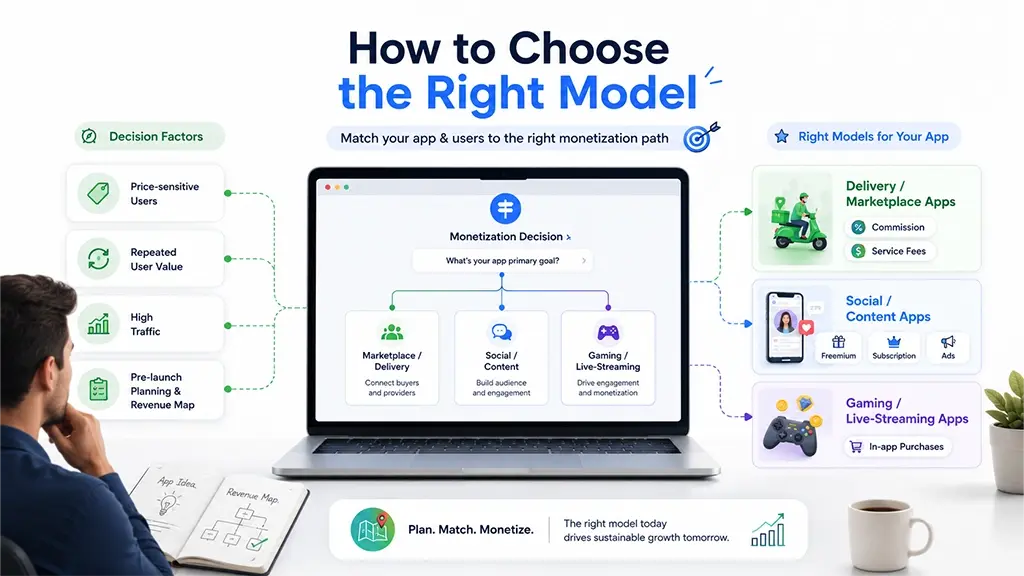
Revenue Model | How You Earn | Best Clone App Type |
|---|---|---|
Commission | The percentage of every transaction | Ride-hailing, delivery, marketplace |
Subscription | Fixed monthly or yearly fee | Grocery, hyperlocal, service platforms |
Freemium | Free base + paid upgrade | Marketplace, business tools |
In-App Advertising | Brands pay to reach your users | High-volume, free-to-use apps |
In-App Purchases | Users pay for specific features | Tiered services, marketplaces |
Smart Apps Use More Than One Model
Many app founders ask how to monetize mobile app businesses without damaging the user experience. In most cases, the answer is not one model but a combination of two or three. For example, Uber makes money with ride commissions and also from the Uber One subscription. Amazon collects from sellers’ commissions, advertising, and selling subscriptions. This hybrid mobile app monetization strategy is why leading apps remain profitable when one revenue stream stagnates. The best way to approach it is to start with one strong model and, on a large scale, add a second model.
Build Your Clone App with the Right Revenue Model from Day One
From the implantation stage, you have to incorporate payment flows, advertising slots, and commission logic, as well as subscription billing structures. It is difficult to incorporate such structures at a later stage. That is why a correct development partner is necessary before you start. Clone app development teams automatically include the revenue model in the app, so you can start making money the moment you launch the app.
Conclusion
A clone app gives you a faster route to market, but revenue still needs to be planned carefully. Mobile app monetization works best when it feels natural to your users and fits the way your platform creates value. That is why the strongest apps do not just copy features; they also build the right earning model from the beginning. Start with one or two models that fit your app category. Test early, measure performance, and improve gradually. The goal is not to charge everywhere possible. The goal is to build a business that earns steadily while users, vendors, and partners stay happy on the platform.
FAQs
1. What is the best revenue model for a clone app?
It depends on the app type, but commissions, subscriptions, service fees, and freemium models are among the most widely used and effective.
2. Can I use more than one monetization model in one app?
Yes. Many successful clone apps use hybrid monetization, such as commissions plus fees or subscriptions plus ads.
3. What does “freemium” mean in app monetization?
“Freemium” means the app is free to use, but premium features cost extra. Users try the app for free, see the value, and then choose to upgrade. It is one of the most effective ways to grow users quickly while still generating steady revenue.
4. Which model gives the most stable monthly income?
Subscriptions are usually the most stable because they create recurring and predictable revenue.
5. When should I plan monetization for my app?
Before launch. Your revenue model affects how the app is designed, priced, and positioned in the market.

 +91-9464826889