






The smart mobility segment is growing rapidly, with the global shared mobility market expected to exceed $405 billion this year in 2026. This massive growth is a unique opportunity for startup founders, business owners and enterprise decision makers. The first question to ask, when applied to building a scalable mobility business, is: how does ride sharing work? Building a platform that thrives under heavy real world demand is key to success.
As soon as you master the algorithmic orchestration, supply-demand equilibrium, and geographic data frameworks that keep a platform humming, you can design a system built for scale.
What is Ride Sharing
Before we deep dive into the architecture of a scalable mobility enterprise, it is important to define the core terminology that governs the modern transport ecosystem. Industry professionals generally define ride sharing as a marketplace model in which multiple passengers travelling along a similar route are in the same vehicle.
What is ride sharing for an urban market? The answer from a business perspective is a need to build an automated matching framework. This software needs to process the routes of the passengers in a timely manner, in order to look ahead for overlapping paths and match riders with an available driver in real time.
For businesses evaluating digital mobility solutions, partnering with a Ride Sharing App Development Company can help accelerate the deployment of these automated matching frameworks and scalable transportation platforms.
Ride hailing vs ride sharing
Many startup founders and marketing leaders use ride hailing and ride sharing interchangeably, but they are very different business models and operational workflows. Ride hailing vs ride sharing: Core distinctions in asset management, user intent, and long-term business scalability.
Fleet utilization patterns
In a standard ride-hailing model, a passenger hires a private car to go directly from point A to point B. The vehicle is exclusive to that one customer for the entire journey. Real ride sharing is actually pooling together different streams of passengers into one vehicle asset. This requires a much more advanced backend dispatch matrix.
Pricing architecture and unit economics
Ride hailing vs ride sharing financial dynamics highlight different structures for profitability as:
- Economics of ride hailing: Profitability is a function of only the individual trip volume, dynamic surge multipliers and constant driver availability.
- Ride Sharing Economics: Profitability is directly related to the fill rate of the vehicle. Mixing several fares on one route results in a higher overall yield per trip, even if individual prices to riders are lower.
Regulatory and compliance frameworks
Operating a commercial ride-hailing fleet often requires businesses to adhere to stringent local taxi regulations, commercial licensing requirements and municipal vehicle caps. Many true shared-route systems benefit from supportive city policies that aim to reduce carbon emissions and traffic congestion. Business owners can leverage infrastructure solutions like ClonifyNow to seamlessly deploy flexible software models that address both operational archetypes in a single marketplace ecosystem.
How does carpooling work
Enterprise decision-makers need to take a hard look at consumer-to-consumer mechanics to build a profitable, highly-scalable shared mobility ecosystem. Knowing how does carpooling work gives you the operational blueprint for managing large scale, multi-passenger routing without running into severe performance bottleneck issues.
Geospatial indexing and routing engines
How does carpooling work? High-performance geospatial data processing is at the core of it. Contemporary mobility platforms are built to discard the traditional grid-based mapping systems that cannot cope with the heavy data requests at scale. Instead, they rely on sophisticated hexagonal spatial indexes to partition the geographic space in very accurate, localised clusters.
Algorithmic path optimization
When a user requests a shared trip, the platform’s backend matching engine immediately calculates the best route. The system looks for active vehicles in the vicinity according to the following criteria:
The vehicle must have vacant seats.
- The driver must be going in the same direction as the rider is going.
- The new passenger shall not unduly delay the passengers already on the vehicle.
Specialised routing algorithms ensure that the system can calculate these complex, multi-stop routes in milliseconds, providing a smooth experience for drivers and riders alike.
Dynamic pricing and fare splitting
Automated pricing engines are a big part of how carpooling works commercially. The platform has to dynamically split fares depending on how far each individual rider goes. Meanwhile, it must ensure that the driver is reasonably compensated for the additional stops on the route.
Peer to peer ride sharing

The ideal choice for startup founders who want to scale fast without putting a lot of capital into buying commercial vehicle fleets is the asset-light approach. Peer to peer ride sharing allows a mobility business to function as a pure digital marketplace, connecting private car owners directly with everyday commuters.
Decentralized supply networks
The main advantage of peer-to-peer ride sharing is that the company does not own or maintain any physical vehicles. Private individuals use their own cars to give you rides, leaving your company’s balance sheet unencumbered by depreciation, insurance maintenance, and fleet upkeep.
Trust security and verification pipelines
“Establishing deep consumer trust is absolutely critical to successfully scaling a marketplace focused on peer to peer ride sharing. Enterprise platforms need to establish automated verification workflows to protect everyone involved:
- Driver Background Ingestion: Live software to immediately verify driver identities, criminal histories and past driving records.
- Automated Vehicle Verification: Digital tracking of documents to verify current vehicle registration, emissions compliance and insurance policies.
- Two Way Rating Systems: Many organizations rely on specialized app development services to implement these verification pipelines, security controls, and marketplace management features efficiently at scale.
Horizontal growth capabilities
The peer to peer nature of the marketplace, based on private cars, allows for rapid expansion into new cities. Business owners don’t have to invest in large local service centers or buy expensive vehicle lots. Building optimised mobile applications over solid architecture such as ClonifyNow enable platforms to onboard thousands of local drivers and start generating marketplace revenue almost immediately.
Strategic Pillars For Building a Scalable Mobility Business
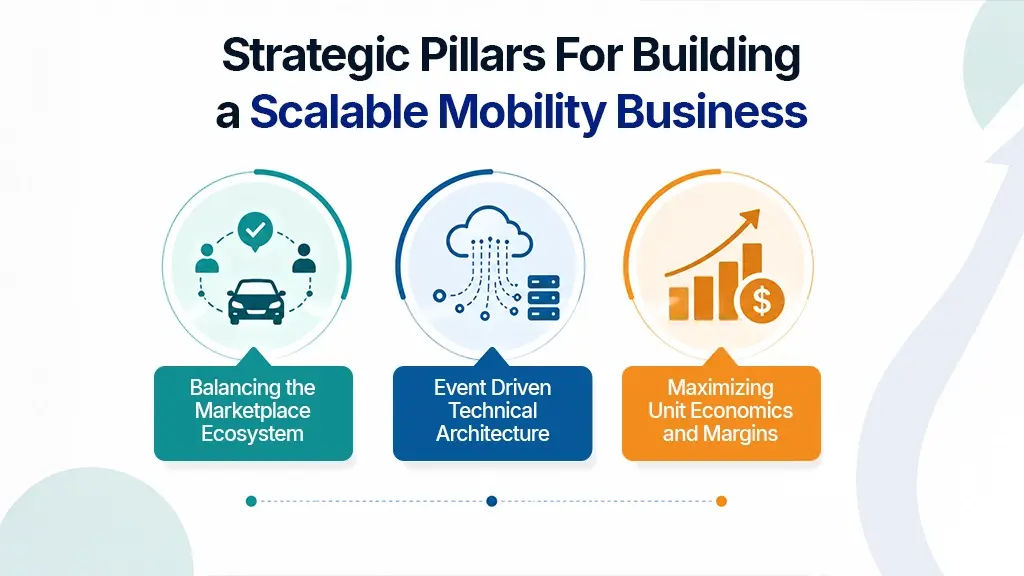
The technical know-how of how does ride sharing work is only half the battle when launching a transport platform. Real, long-term enterprise scalability requires an intentional focus on the core operational pillars that keep a multi-sided marketplace stable during periods of rapid growth.
Balancing the marketplace ecosystem
Many new mobility startups suffer from one Achilles’ heel: a critical mismatch between supply and demand. Too many riders and not enough drivers, your wait times increase and your users abandon your app fairly quickly. On the other hand, too many drivers without enough consistent ride requests will cause drivers to lose earnings and migrate to competing platforms.
Event driven technical architecture
But as your platform grows to thousands of concurrent rides, the traditional database structures will start to falter under the heavy load. For mobility businesses that need to scale, you need event-driven system designs where driver apps stream live GPS coordinates every few seconds. This information is streamed into memory-based data caches through high-throughput message streams directly.
Maximizing unit economics and margins
If you want to build a sustainable business, you’ve got to get your platform out of total dependence on VC money and into outright profitability. This means optimising your platform fees, building strong B2B corporate travel programs and using automated route matching to make the most revenue per mile.”
Achieving Enterprise Scale in Shared Mobility

Building a strong, market-leading mobility platform requires a combination of complex geospatial software, strong marketplace trust and highly efficient cloud infrastructure. If you understand exactly how does ride sharing work at the technical level, you have the foundation you need to disrupt traditional transit networks and capture meaningful market share.
You don’t need to build these very complex matching algorithms and tracking systems from the ground up, whether you’re a startup founder, enterprise leader or business owner. You can also leverage high-quality, enterprise-grade application blueprints from specialised developers, such as ClonifyNow. This can save your business years of costly technical trial and error.
FAQs On How Does Ride Sharing Work
What is the difference between ride sharing and ride hailing?
Ride hailing provides a private vehicle for a single passenger or group, while ride sharing pools multiple riders traveling in similar directions into one vehicle, improving efficiency and reducing costs.
How do ride-sharing apps match riders and drivers in real time?
Ride-sharing platforms use GPS tracking, geospatial indexing, and AI-powered matching algorithms to connect riders with nearby drivers while optimizing routes, travel times, and vehicle occupancy.
Is ride sharing profitable for mobility startups?
Yes, ride sharing can improve profitability by increasing vehicle utilization and combining multiple fares into a single trip, helping platforms generate higher revenue per mile traveled.
Why is carpooling becoming more popular in 2026?
Rising fuel costs, urban congestion, sustainability goals, and advances in real-time ride-matching technology are driving increased adoption of carpooling and shared mobility services globally.
What technologies are essential for building a scalable ride-sharing platform?
Scalable ride-sharing platforms rely on real-time GPS tracking, cloud infrastructure, event-driven architecture, dynamic pricing engines, secure payment systems, and AI-based route optimization for reliable operations.



 +91-9464826889