






Are you a SaaS company looking to acquire more customers? You need to understand and track key SaaS metrics for this, as this will help you make informed decisions and drive growth in both your customer base and revenue. We all know SaaS does not work like traditional businesses. Here, businesses can track the performance even after the point of interaction. As SaaS is based on a subscription model (we have discussed the SaaS business model in our blog, “Inside the SaaS business model,” in detail), businesses can measure their performance even after conversions. They can measure how frequently the customer is logging in and at what time of the day the activity is increasing or decreasing, and more. Traditional businesses can only track data at the point of purchase or browsing behavior. This gives SaaS a competitive edge. In this blog, we have covered the most valuable KPIs that businesses should track and that will help them make strategies and plan their future.
What are SaaS metrics?
SaaS metrics are data points that help software-as-a-service businesses track their performance in terms of revenue, customer behavior, growth, and retention. Without tracking these metrics, companies can’t clearly understand whether they are moving in the right direction and what they should do to grow their business. We know what is coming to your mind next. What are these metrics? How do they help SaaS companies take the right direction? How to calculate B2B SaaS metrics. The following section will make you familiar with all the SaaS metrics.
Key SaaS Metrics Every Business Should Track
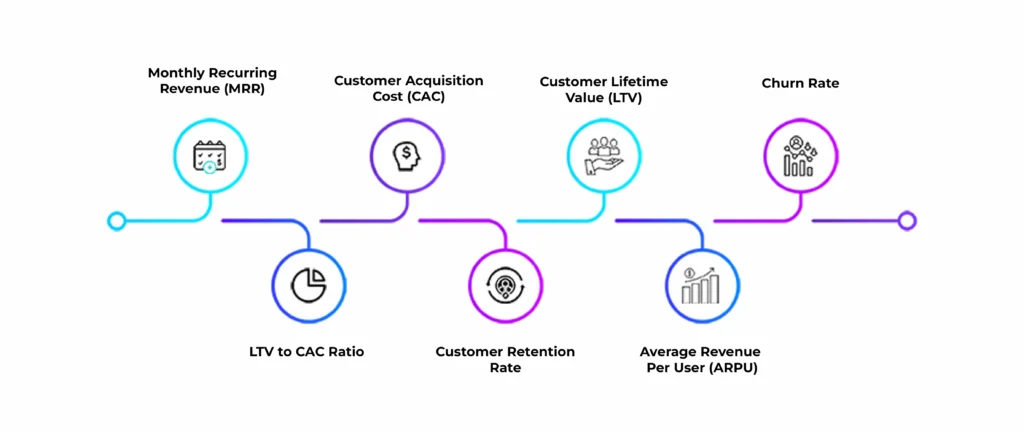
Whether you are a SaaS startup that has just started its services or you are a well-established SaaS company, you should know about some essential metrics. These metrics will give you a clear picture of how your business is performing and how you can improve.
1. Monthly Recurring Revenue (MRR)
MRR stands for monthly recurring revenue and measures the income your SaaS company is earning from subscriptions. They are broadly divided into three types:
New MRR: This is the additional revenue earned from new customers/subscribers.
Expansion MRR: This is the extra revenue that a business gets from their existing customers, along with their original subscription.
Churned MRR– Revenue that has disappeared due to cancellations of subscriptions.
The net MRR is calculated after considering all the above three components.
Net MRR = New MRR + Expansion MRR − Churned MRR
2. Customer Acquisition Cost (CAC)
Customer acquisition cost measures the cost a business incurs to acquire a new customer, such as in marketing and sales. So, to calculate (CAC), everything must be taken into account, such as advertising, sales, commissions, etc. High CAC means a business is struggling to remain profitable.
CAC = Total Sales & Marketing Spend ÷ Number of New Customers Acquired
So, if you spend ₹10000 on sales and marketing in a quarter and earn 50 new customers, your CAC will be the following:
CAC = ₹10000 ÷ 50 = ₹200 per customer
3. Customer Lifetime Value (LTV)
Customer lifetime value is the total revenue a business earns through a customer during their relationship. It helps businesses know how much they can expect to earn from a customer. For calculating customer lifetime value (LTV), the following formula is used:
LTV = Average Revenue Per User (ARPU) ÷ Churn Rate
Where average revenue per user (ARPU) is the revenue generated by each user over a specific time. It is calculated as:
Total revenue/Total users
And churn rate is discussed in the next section. Higher LTV indicates better customer retention and better long-term profitability.
4. Churn Rate
Churn rate helps companies know how much business they are losing. It calculates the percentage of people who stopped using your services. Churn rate is one of the most critical metrics, as it helps businesses understand the overall health of their business.
The formula for churn rate
(Customers lost ÷ customers at start of period) × 100
So if you have 400 customers and you lost 40, your churn rate will be
40/400*100 = 10%
High churn indicates that users are not liking the product, or there is strong competition, or the product is not giving value to the customer. Churn rate helps businesses change their strategies, improve their software features or services, and more.
5. LTV to CAC Ratio
The LTV to CAC ratio is another important metric that helps businesses compare the value of a customer to the cost of acquiring them. A healthy ratio is 3:1, which means you earn three times more than what you spend.
Formula—LTV (Lifetime Value)/Customer Acquisition Rate
6. Customer Retention Rate
Customer retention rate helps companies measure how many customers they have retained over time, excluding new customers. In simple words, it helps them know how well they have maintained their relationship with their customers.
Formula: (Customers at the end of the period) – (new customers/customers at the start) * 100
Higher customer retention indicates that customers are satisfied with your software or services. Your product is a better fit for the market, and you will have sustainable growth.
7. Average Revenue Per User (ARPU)
We have discussed average revenue per user in one of the previous sections. However, here we will help you know this parameter in detail. ARPU helps companies measure the revenue that they earn from each user over a specific period of time.
Formula- ARPU = Total Revenue ÷ Number of Active Customers
One can increase ARPU by upscaling the premium plan and introducing additional features.
Some Common Mistakes that Businesses Should Avoid
You might not know, but in spite of knowing key SaaS metrics, many businesses fail to improve customer retention and their revenue because they don’t use them properly. Some common mistakes they make are:
They ignore churn rate.
They track too many metrics.
They don’t track the data regularly.
So, to get the most value from these vital parameters, businesses should focus more on those that truly help them drive growth.
Final Words
FAQs
1. What are SaaS metrics?
SaaS metrics help businesses know how they are performing. They help them understand customer behavior and track subscriber growth and decline, which helps companies make decisions based on data, not on guesswork.
2. Why are they important?
They are important because they help businesses know how customers are interacting with their product. They know how much they are earning, and if they are not performing well, they can change their strategies or make improvements.
3. What are the most important metrics to track?
Some of the most important metrics include Monthly Recurring Revenue (MRR), Customer Acquisition Cost (CAC), Customer Lifetime Value (LTV), churn rate, customer retention rate, and more.
4. What is the difference between MRR and ARPU?
MRR (Monthly Recurring Revenue) measures the total predictable monthly income from subscriptions, while ARPU (Average Revenue Per User) measures the average revenue earned from each customer.
5. How do SaaS companies improve their performance using metrics?
SaaS companies can improve metrics by analyzing metrics such as churn rate, CAC, and LTV. These insights will help them reduce customer loss, improve customer experience, and increase revenue.





 +91-9464826889