





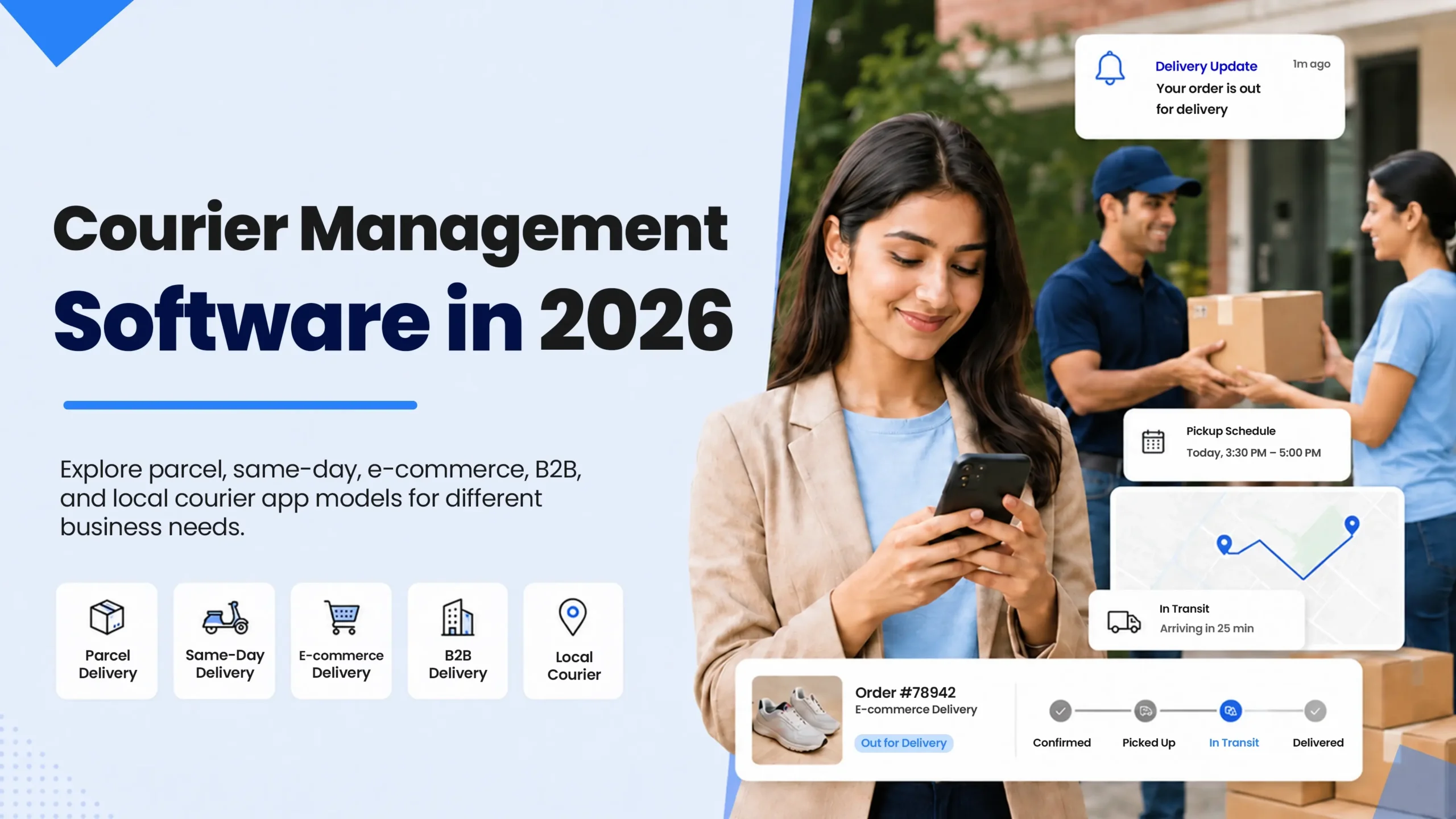
Remember the last time you bought something online? You did not need to contact a delivery service, and you did not go to a post office. You placed a purchase, got a confirmation, and were able to track your order until it arrived at your home. This is how online shopping should be. This is the experience that good courier management software is built to recreate. If you own a courier company, manage an e-commerce business, or want to start an on-demand delivery business, building a delivery app is a necessity. It is the best investment you can make for your business today. This guide provides a comprehensive overview of the delivery app space. It includes the types of apps you can build, core features, the development process, costs, and how to get to market faster.
Why the Courier Delivery Market Is Growing Fast
The courier and parcel delivery market is in a period of strong global expansion. According to Statista’s global last-mile delivery market data, the last-mile delivery market is expected to grow to over $200 billion by 2027. The delivery industry is changing because of the increasing popularity of online shopping, growing expectations for same-day delivery, and a growing preference for mobile-first services. People do not like waiting. Everyone wants to send and receive deliveries quickly, track their package in real time, and pay digitally. All from their phone. Businesses relying on phone calls and manual coordination are losing customers every day to competitors who already have a powerful courier delivery app in place.
What Is Courier Software Management and How Does It Work?
A digitally based courier delivery system connects senders, delivery agents, and recipients in one integrated mobile app. Users can book and assign deliveries, track shipments, and complete the entire delivery process within the app. Here is a simplified version of the process:
- The user opens the app and fills in the pickup and drop-off locations
- The system finds the closest delivery agent and assigns them to the job
- The agent picks up the package and drives to the drop-off location
- The recipient tracks the package and receives status updates via courier delivery tracking software
- The payment is processed, and both sides can rate each other
That is the level of efficiency and power that a modern delivery platform can provide.
Types of Courier Delivery Apps
Before building a courier delivery app, it is important to determine which type of delivery app best aligns with your business goals.
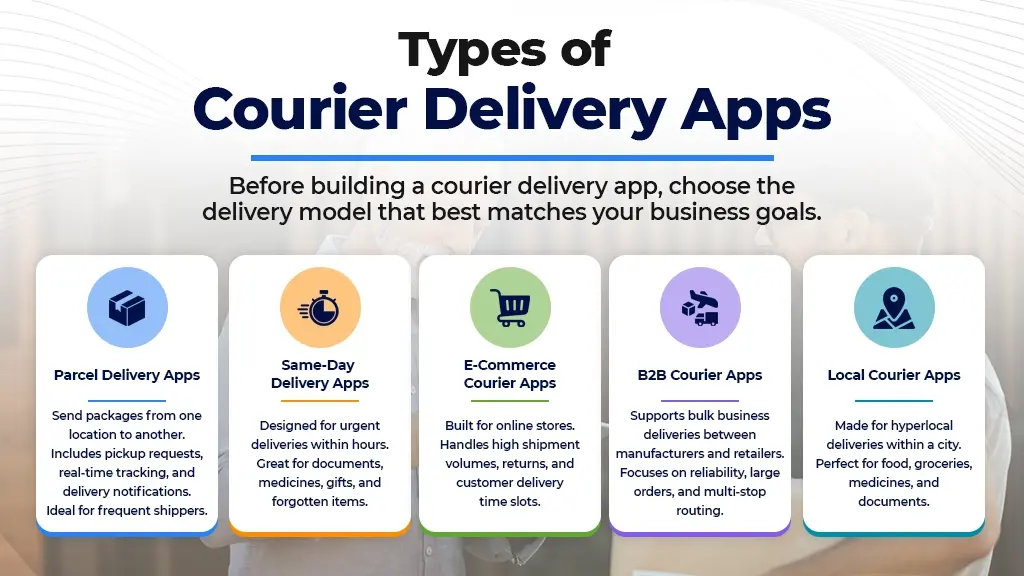
1. Parcel Delivery Apps
Parcel delivery apps give users the ability to send packages from one location to another. Users can request pickups, track packages in real time, and receive delivery notifications. These apps are ideal for individuals and businesses that ship frequently. DHL Express and FedEx Mobile are popular examples.
2. Same-Day Delivery Apps
These apps promise delivery within just a few hours after an order is placed. They are useful for sending documents, medicines, gifts, or forgotten items where timing is critical. Uber Connect and Postmates are well-known examples in this space.
3. E-Commerce Courier Apps
These apps are designed to integrate with online stores. They handle large shipment volumes, manage returns, and allow customers to choose delivery time slots. Amazon Logistics and Flipkart Logistics handle millions of orders every month using this model.
4. Business-to-Business (B2B) Apps
These apps handle bulk inter-business deliveries. It typically is between manufacturers and retailers. They focus on reliability, tracking large orders, and efficient multi-stop routing. Trusted names in India include Delhivery and Blue Dart.
5. Local Courier Apps
These apps work within a specific city or area, quickly delivering food, medicine, groceries, and documents over short distances. This type of courier management software service connects users with nearby agents for hyperlocal delivery needs. Dunzo in India and Glovo in Europe are strong examples of this model.
Business Models to Consider
The type of business model you choose determines how your app generates revenue and serves users.
Courier and Postal Service Model: A digital front end for an existing courier brand. Customers book, track, and manage deliveries on a branded app — exactly how FedEx and DPD operate.
Package Tracking Aggregator: All tracking data from multiple carriers is consolidated into one place. Users input their tracking IDs and receive updates regardless of which courier company is handling the shipment.
Branded Delivery with Merchant Integration: This model is used by e-commerce businesses to provide customers with fully branded delivery and tracking. This is from order confirmation right through to delivery.
Uber-Like On-Demand Marketplace: One of the most scalable models available. It assigns delivery requests to nearby independent agents in real time. It is similar to how on-demand taxi app solutions transformed the ride-hailing industry. It is fast, easy to scale, and requires no owned fleet.
Key Benefits of a Courier Delivery App for Your Business
Investing in courier delivery app development brings measurable advantages to your daily operations:
- Convenient Booking—Customers can arrange pickups and confirm deliveries without calling anyone.
- Package Tracking—Live last mile delivery solutions allow customers to track their own deliveries, reducing support queries.
- Flexible Payment — Cards, digital wallets, and cash on delivery give customers full choice.
- Automated Order Assignment—Orders are assigned to available agents automatically, eliminating manual coordination.
- Centralized Delivery Management — All agents, routes, and performance are monitored from one dashboard.
- Automated Customer Updates — Customers receive status updates at every delivery milestone.
- Insightful Reporting — Order fulfilment rates, revenue, peak times, and agent performance are tracked clearly.
- Less Manual Work—Digital records replace manual sheets automatically.
Must-Have Features in Every Courier Delivery App
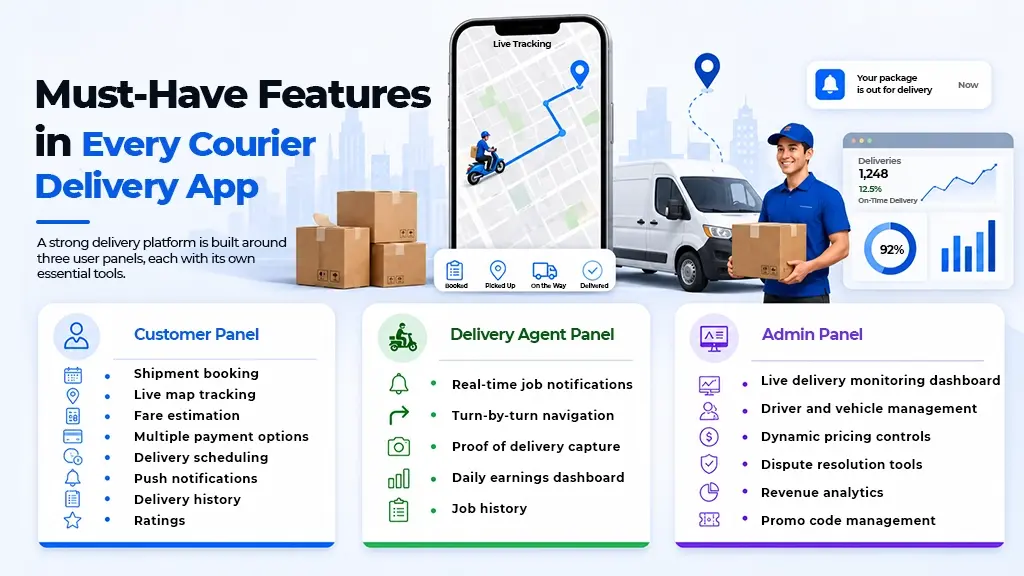
A strong delivery platform is built around three user panels. Each has its own set of essential tools.
Customer Panel: Shipment booking, live map tracking, fare estimation, multiple payment options, delivery scheduling, push notifications, delivery history, and ratings.
Delivery Agent Panel: Real-time job notifications, turn-by-turn navigation, proof of delivery capture, daily earnings dashboard, and job history.
Admin Panel: Live delivery monitoring dashboard, driver and vehicle management, dynamic pricing controls, dispute resolution tools, revenue analytics, and promo code management.
Step-by-Step Development Process
It takes a significant amount of time to build a delivery app. There are multiple stages involved, and each one matters.
1. Market Research—Understand your users, analyze competitors, and identify where you can serve better.
2. Build the MVP—Launch with core features first and test with real users before investing in advanced tools.
3. UI/UX Design —Design all three panels: simple for customers, distraction-free for drivers, and comprehensive for admins.
4. App Development —Build GPS tracking, payment integrations, dispatch logic, push notifications, and the backend.
5. Testing —Test every scenario: bookings, cancellations, payments, tracking, and peak load performance.
6. Launch and User Acquisition — Deploy to app stores and use discounts and referral bonuses to attract early users.
7. Maintenance and Updates—Improve the app based on feedback, remove bugs, and add features as the business grows.
A professional courier delivery app development company handles all of these stages. It manages your time, reducing mistakes, and gets you to market faster.
How Much Does Courier Delivery App Development Cost?
The budget for a courier delivery app depends on a few key decisions you make for your business:
- Development partner—Cost varies based on the company’s expertise, team size, and engagement model.
- Platform choice—Building for one platform costs less; building for both iOS and Android costs more.
- Features included—Basic login and payment features cost less; real-time analytics and route optimization add to the budget.
- MVP vs. full app—A minimum viable product costs significantly less than a fully developed platform.
- Technology stack—Advanced or specialised technologies improve quality, but also increase cost.
- Marketing and branding — Account for user acquisition costs once the app goes live.
Why Clone-Based Development Is the Smarter Path
The standard method of building a courier app will cost the business a lot of money and will take a long time (4 – 6 months) to develop. For this reason, the majority of businesses (especially first-time launch businesses) do not take the time or allocate the budget to take the standard method to develop the app. A business will be much better served if they take the route of using clone app development to make the app align with its brand. With the developed clone, the business will have a courier delivery platform that contains all three panels and has been tested for functionality. ClonifyNow offers a fully integrated delivery app solution with a real-time tracking system, automated dispatch, flexible payment options, push notifications, route optimization, and a complete admin analytics dashboard. With this app, businesses can expect a cost-effective and rapid go-live within weeks instead of several months. Instead of starting from zero, you get a fully functional parcel delivery software with all three panels ready to go.
Conclusion:
The delivery of parcels and the digitization of logistics are growing fast. Real-time tracking, instant booking, and in-app payment are no longer extras. They are what every customer expects as standard. Strong courier management software lets you handle customer expectations efficiently at the scale your business needs. digitization. If you’re ready to build your application, visit our courier mobile application as the first step to try building your digitization infrastructure with our delivery mobile application solutions, or try our clone application development solutions.
FAQs about Courier Management Software
1. What is courier management software?
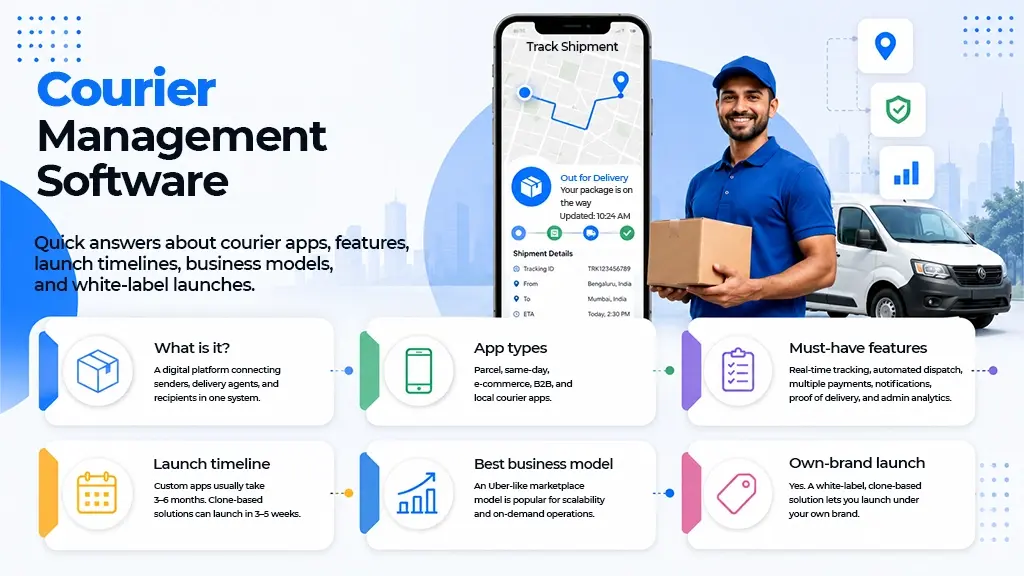
It is a digital platform that connects senders with delivery agents through a single interface. It allows users to book deliveries, track packages through courier delivery tracking software, and receive shipments with complete visibility at every stage.
2. What are the different types of courier delivery apps?
The main types are parcel delivery, same-day delivery, e-commerce courier, B2B, and local courier apps. Each serves a different business model and customer need.
3. What features must a courier delivery app have?
Essential features include real-time tracking, automated dispatch, multiple payment options, push notifications, proof of delivery, agent management, and a full admin analytics panel.
4. How long does it take to launch a courier delivery app?
A custom build usually takes 3–6 months. With a courier delivery app development company using a clone-based approach, businesses can typically launch in 3–5 weeks.
5. What is the best business model for a courier app?
The Uber-like marketplace model is the most preferred for scalability. It connects senders with nearby independent agents. Making it is a powerful on-demand delivery app model for new businesses.
6. Can I launch a courier app under my own brand?
Yes, you can use a white-label, clone-based solution, which allows you to customize the app but still use the core platform.


 +91-9464826889